
A virtual gallery tour in one minute: the night garden of Julien Louvier Legrand
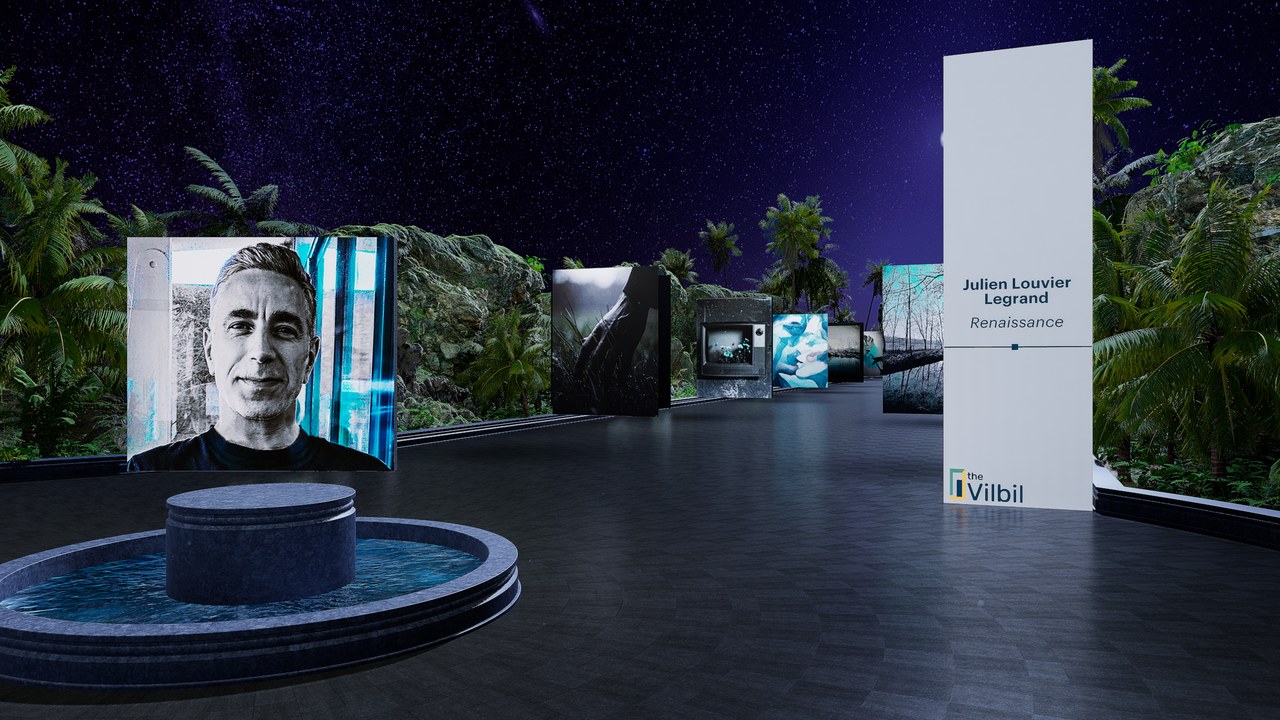
Most virtual gallery tours begin with a menu. This one begins with a fountain.
You arrive at night. A round basin of dark water lies in front of you, and above it hangs a black-and-white portrait of the artist, crossed by stripes of turquoise. To the right stands a white stele with his name and the title of the exhibition, Renaissance. Behind them a paved alley runs straight ahead between palms and mossy rock, under a violet sky with more stars than a city allows.
That is the whole map. This virtual art gallery is a single path, about eighty metres long, and the pictures stand along it on tall steles, two by two, left and right, like trees in an avenue. There is nothing to choose and no way to get lost: you walk through it as you would walk through any garden at night, towards the light.
There is nothing to learn. Walking here means pointing: click or tap on the paving ahead, and the garden carries you to that spot in about a second and sets you down. Move once past the stele, and the moon comes out from behind it, low over the far end of the alley. Then you look, and point again.
The first thing you notice is size. A 3D virtual gallery is not a page of thumbnails: the works have dimensions, and here they are large. Living water is more than three metres tall. You do not look at it so much as stand in front of it, the way you stand in front of a wall, and it grows as you come closer.
The second thing is colour, or how little of it there is. The pictures are black and white. Then, in each one, something is turquoise. Flowers growing out of an old television set in Flower pot. One eye of a cat in Mint. A single bloom among grey leaves in Hydrangea. By the third stele you are looking for the turquoise before you look at anything else.
The exhibition has a name for what you are walking through. Its own text calls it “a visual territory where digital arts and photography engage in dialogue”.
The third thing takes a little longer to find. Every stele has two faces. On the way out you see one row of pictures; turn round at the far end, come back towards the fountain, and you are in a second exhibition that was behind your back the whole time.
If you stop only once, stop at Living water, the second stele on your right. Forest and clouds above, stones below, and the surface of the water drawn across the middle like a horizon. In the garden that line hangs at the height of your eyes. Go up to it and stay a while: the nearer you are, the less garden is left around the water, and the harder it is to say which side of the surface you are on.
One more thing is worth knowing before you go. Click or tap on a picture and you are set in front of it. Do it again, and the garden steps aside: the work stands on its own, without the night on it, as the artist made it. Leave it, and you are back among the palms.
A virtual exhibition has one advantage over a real one: it is night there whenever you arrive. This one opens in your browser, with nothing to install. From the fountain to the far end is six or seven clicks, a few seconds of movement in all. The minute in the title is what the garden takes if you stop at the pictures on the way, and stopping is the point. Nobody will hurry you if you take ten.
The garden is Julien Louvier Legrand’s vilbil gallery, and the door is here: vilbil.art/en/julien-legrand
About the artist. Julien Louvier Legrand is a visual artist whose work joins experimental photography and digital composition. Six years of training in graphic design and visual communication, followed by professional work in agencies, gave him a designer’s rigour and a close attention to how perception is built. His influences run from René Magritte and Robert Doisneau to Enki Bilal, Charlélie Couture and the graffiti artist Mod 2. He photographs urban landscapes with a deliberately minimalist smartphone and reworks them through collage, digital montage and radical post-production: colour layering, motion blur, digital cropping, light painting. His practice is committed to inclusion and to sustainability, from eco-friendly printing materials to the aim of energy self-sufficiency for his tools. “Renaissance”, his exhibition on The Vilbil, is conceived as a journey through images that questions speed, identity, urban memory and the ethics of looking in the digital age.
About The Vilbil. The Vilbil is a premium no-code platform for flagship 3D virtual galleries. An artist can build a photorealistic gallery in minutes and place it directly on their own website. Sculptures appear in it as interactive digital twins. Visitors open it in a standard browser, on any device, 24/7, with nothing to install. The Vilbil takes no commission on sales: 0%.